
Tutorial
The Complete Body Measurements Guide for Clothes Shopping Online
A complete body measurements guide for clothes shopping online, covering bust, waist, hips, inseam and more, plus how to read any brand's size chart.
Published October 13, 2026
You click "add to cart" on a medium, because a medium is what you always order. Three days later the box shows up, and the shirt is snug across the shoulders but hangs loose everywhere else. Nothing about your body changed in the meantime. That brand's size chart just wasn't measuring the same things you assumed it was. This is the exact problem a body measurements guide for clothes shopping is meant to solve: your own numbers stay constant no matter whose tag is sewn into the garment, so learning them once pays off every time you shop somewhere new.
A size label, in the end, is just a guess a brand makes about who its clothes are for. No industry authority defines what "medium" or "size 8" has to measure, so every retailer sets its own internal chart based on its target customer, where the garments are manufactured, and whatever design choices happen to be in fashion that season. Two "size 10" dresses from different labels can be cut for genuinely different bodies. Your waist measurement doesn't have that problem. It's the same number no matter whose chart you're checking it against, and once you have it, you can compare it directly instead of hoping someone else's "medium" lines up with yours.
If you don't already know your own numbers, here's how to measure your body without a tape measure using things you probably already own. Once you've got them jotted down, everything below walks through what each number is actually used for and how to check it against a brand's chart without second-guessing yourself.
Why You Need a Body Measurements Guide for Clothes Shopping, Not Just a Size Label
Clothing sizes were never standardized to begin with. No governing body decides what a "medium" or "size 8" has to measure, so every brand builds its own chart around its target customer, its country of manufacture, and whatever design philosophy it happens to favor. Even within a single brand, sizing can drift over the years as design teams change.
Body measurements skip past all of that. Your waist is your waist, regardless of whose tag is on the garment. Once you know your own numbers, you can check them against any chart directly, which beats picking "the size I usually wear" and hoping for the best.
The Key Measurements Used in Clothing Size Charts
Most size charts are built from the same handful of core measurements. Here's what each one means and why it shows up on the chart at all.
Bust/chest — Circumference around the fullest part of the chest. Determines fit across the chest, shoulders, and upper torso in tops, dresses, and jackets.Waist — Circumference at the natural waistline. Sets fit for pants, skirts, and fitted tops at the narrowest point of the torso.Hips — Circumference at the fullest point of the hips and seat. Governs fit for pants, skirts, and dresses below the waist.Inseam — Length from the crotch seam to the hem. Determines pant and trouser length.Shoulder width — Distance from one shoulder point to the other. Affects how tops and jackets sit across the upper body.Sleeve/arm length — Length from shoulder seam to wrist. Determines where sleeves end on jackets, shirts, and sweaters.Rise — Distance from the crotch seam to the waistband. Affects where pants sit on the body, from low-rise to high-rise.
Bust/Chest
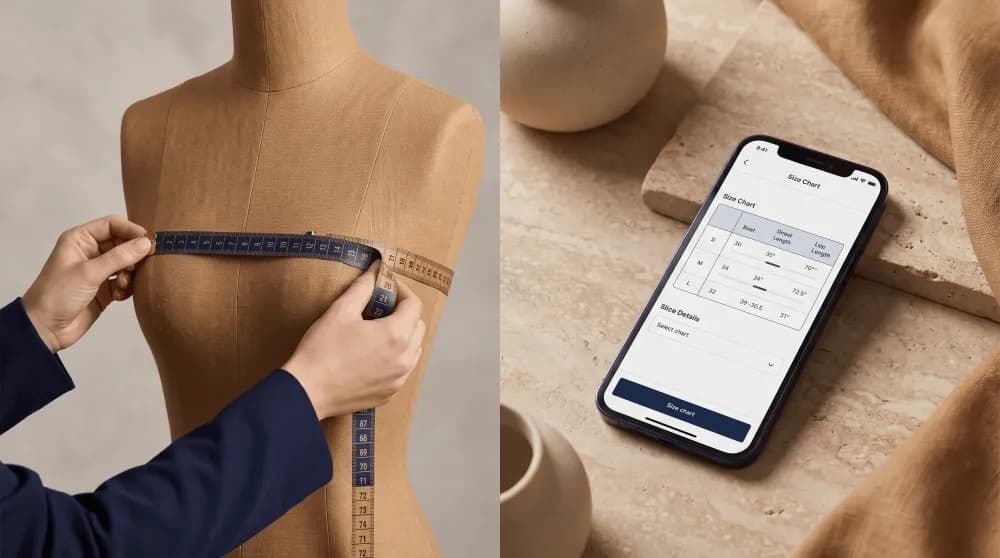
Bust or chest is the circumference around the fullest part of your chest, measured straight around rather than at an angle. Brands lean on this number for tops, dresses, jackets, and anything else fitted through the upper body, and they tend to size shoulders alongside it, since the two areas usually scale together.
Waist
Waist trips up more people than any other measurement on this list. It's taken at your natural waistline, the narrowest point of your torso and usually just above the navel, not wherever your jeans happen to sit. That distinction matters because a waist measured at hip level throws off fit predictions for pants, skirts, and fitted dresses alike.
Hips
Hip measurement runs around the fullest part of your hips and seat, typically a few inches below the waist. Paired with your waist number, it tells a brand how much your body tapers between the two points, which matters for pants, skirts, and dresses cut close to the body.
Inseam
Inseam covers the length from the crotch seam down to the hem. It's the number that decides whether pants will be the right length before width or fit ever enter the picture, and it's specific to bottoms, so it doesn't appear on charts for tops.
Shoulder Width
Shoulder width runs from one shoulder point to the other, measured across the back. It shows up most often on charts for structured jackets and blazers, where a bad fit through the shoulders is hard to correct afterward, and it generally determines how a top or jacket sits across the upper body.
Sleeve/Arm Length
Sleeve length starts at the shoulder seam and ends at the wrist. Jackets, button-downs, and sweaters depend on it more than casual tops do, mostly because a sleeve that's the wrong length is harder to fix than a hem or a waist.
Rise
Rise measures the distance from the crotch seam to the top of the waistband, and it's what separates a low-rise cut from a high-rise one. Two pairs of pants can share an identical waist and inseam and still fit completely differently because of rise, so it's worth checking on any chart for jeans or trousers.
A Few More Measurements Some Charts Ask For
The seven measurements above cover most clothing categories, but a handful of brands, especially for outerwear, swimwear, or fitted knitwear, ask for a couple of extra numbers. Knowing what these are for means you're not caught off guard the first time a size chart lists one.
Underbust. The circumference just beneath the chest, used mainly for structured dresses, swimwear, and some fitted tops where the band, not the cup, determines the base fit.
Thigh and calf. Occasionally listed on charts for fitted trousers, leggings, or tall boots, where the circumference of the leg itself, not just the waist and hip, affects whether something slides on comfortably.
Neck. Standard on dress shirt charts, since a collar that's a half-inch off in either direction is uncomfortable in a way that's hard to ignore.
Torso length or "rise to shoulder." Occasionally used for jumpsuits and overalls, where both the vertical and horizontal fit need to line up at once.
None of these show up often enough to be worth measuring preemptively. Just take them if a chart specifically calls for them, using the same straight-around, non-tugged approach as the core measurements above.
How to Read and Use a Brand's Size Chart Correctly
Most sizing mistakes don't come from measuring wrong. They come from skipping the measuring step entirely and clicking whatever size you always order. Here's a more reliable process.
Start with your own measurements, not your usual size. Have your bust, waist, and hip numbers on hand before you open a product page.Find the brand's specific size chart, usually linked near the size selector on the product page. Don't borrow a chart from a different brand, even one you've bought from happily before.Match each measurement to the chart's ranges on its own. Your bust might land in their "M" column while your waist sits in their "L" column. When your numbers span two sizes, let the garment decide: a stretchy knit top can usually go with the smaller size, while a structured, non-stretch blazer tends to fit better sized up.Check which measurements actually apply to the garment. A fitted dress chart needs your bust, waist, and hip numbers. A trouser chart needs waist, hip, inseam, and rise. Not every measurement matters for every item.
It takes longer than clicking "Medium" out of habit, but it's the difference between shopping by guesswork and shopping by evidence.
Common Measuring Mistakes That Throw Off the Numbers
A few habits are responsible for most of the bad measurements people end up working from, and none of them are hard to fix once you know to watch for them.
Measuring over bulky clothing. A tape measure taken over a sweater or a jacket adds inches that aren't actually there. Measure over thin, snug clothing or directly against skin for the most accurate read.
Pulling the tape too tight. A snug tape measure and a tight one aren't the same thing. The tape should sit against your body without compressing it, roughly the same tension you'd want from a well-fitting waistband.
Measuring standing unnaturally straight. Stand the way you normally stand. Sucking in or straightening up more than usual shaves numbers off your waist and chest that won't match how you actually move through your day.
Skipping the re-measure. Bodies shift gradually for all kinds of ordinary reasons, and a measurement from two or three years ago may no longer match. It's worth rechecking your numbers every six months to a year, especially before a season where you're planning to buy several new pieces.
Only measuring once. A single pass can be off by half an inch in either direction, easily enough to tip a borderline size one way or the other. Measuring twice and averaging the two numbers catches most of that error.
Why the Same Measurements Mean Different Sizes at Different Brands
Here's the part that trips people up even after they've done everything right: your measurements can be dead accurate and still translate into a different size label at every store you shop. That's because each brand's chart reflects its own internal standards, shaped by its target customer, its country of manufacture, and design decisions that have nothing to do with your actual body. A size 8 at one brand and a size 12 at another can both be cut for the same set of measurements. That's not a flaw in your numbers. It's proof that the label was never the reliable part of the equation, so expect the variation and measure instead of guessing.
How Technology Has Changed Body Measuring for Shopping
Measuring seven or eight points on your own body once is manageable. Doing it consistently, every time you check a new brand's chart, without the numbers drifting between sessions, gets tedious fast.
Shaku handles this differently. Feed it two ordinary phone photos, and it pulls more than 30 body measurements and checks them against actual brand size charts to suggest a best size match for a specific item. Instead of cross-referencing your waist and hip numbers against every retailer's chart by hand, the comparison runs automatically, in seconds, based on your actual body.
This matters most if you shop across a lot of different brands, since it removes the repeated manual work of re-checking your numbers every time you order somewhere new. It's not a promise of a guaranteed perfect fit (no measurement system can honestly claim that); it's a faster, more consistent way to land on a best size match than working through a chart with a tape measure and a calculator.
If you'd rather measure by hand and skip the photos altogether, here's how to measure your body without a tape measure using household items and things you already have lying around. For more on how this kind of measurement technology actually works, see how AI body measurement is revolutionizing online tailoring.
Measurements Support a More Inclusive Approach to Sizing
There's a bigger reason to shop by measurements instead of size labels: standard size charts were never built to reflect the full range of real bodies. Leaning on actual numbers, rather than a label built around one narrow body type, is part of how the industry is slowly becoming more useful to more people. Shaku's post on leveraging sizing solutions to promote diversity and body positivity in fashion goes deeper on this.
Practical Takeaway
Size labels are shorthand a brand uses for its own convenience, not a standard you can count on anywhere else. Your measurements are the one number that stays the same no matter whose chart you're reading. Learn your bust, waist, hips, inseam, shoulder width, sleeve length, and rise, match them against each brand's own chart, and you'll spend less time returning things that don't fit and more time wearing clothes that actually do.
Frequently asked questions
How do I measure my waist correctly?
Wrap the tape around your natural waistline, the narrowest point of your torso and usually just above the navel, rather than wherever your pants currently sit. Keep the tape level and snug, not pulled tight.
Which measurements matter most for buying pants?
Waist, hip, inseam, and rise. Waist and hip decide how the pants fit through the top, inseam sets the length, and rise determines where the waistband lands on your body.
Do I need all of these measurements for every purchase?
Not usually. Match the measurements to the garment. A fitted top mostly needs bust, waist, and shoulder width, while pants need waist, hip, inseam, and rise. Check what the brand's own size chart lists and focus on those.
How often should I re-measure myself?
Roughly every six months to a year covers most people, though it's worth rechecking sooner if your weight, activity level, or routine has shifted noticeably, or before a season where you're planning several new purchases.