
Fashion
Rectangle Body Shape Outfits: Best Styles and Silhouettes to Wear
A complete guide to rectangle body shape outfits: how to add waist definition, work with straight lines, and play with proportion, on your own terms.
Published October 13, 2026
Rectangle body shape outfits are quietly having a moment. If you've got a straighter build (bust, waist, and hips all reading close to the same width) the current wave of sleek tailoring, boxy blazers, menswear-inspired suiting, and '80s-style power dressing lines up almost perfectly with what you already work with. Straighter lines are the whole point of this shape, and right now that's exactly what's trending.
What "Rectangle" Actually Means
A rectangle shape describes proportion, not a problem. The bust, waist, and hips measure close to the same width, with less curve difference between them than you'd see on an hourglass, and no major width shift at the shoulders or hips like you'd find on a pear or an inverted triangle.
That's really all it is. A lot of style guides treat "rectangle" like a shape that needs fixing, and that framing misses the point. Straight, even proportions are the foundation that architectural fashion, tailoring, and clean minimalism are built on. For a fuller comparison of how this shape stacks up against others, Shaku's guide to the most common body types breaks down the full picture, and this post is one of four shape-specific deep dives branching off Shaku's complete guide to dressing for your body shape if you want the wider framework.
Why Rectangle Shapes Are Built for What's Trending Now
Fashion swings back and forth between eras that celebrate curve and eras that celebrate line, and right now we're solidly in a line moment. Boxy jackets, straight-leg trousers, architectural coats, and structured shoulders are everywhere, and all of them read cleanest on a body where the silhouette isn't broken up by a lot of curve.
Menswear-inspired tailoring (a sharp blazer, a crisp button-down, trousers with a real crease) hangs the way it's designed to hang on straighter proportions. The same goes for '80s power dressing: strong shoulders, boxy jackets, a straight line through the torso. Both are having a real resurgence, and a rectangle shape wears them without needing to adjust a thing. None of that rules curve out, though. It just means you're starting from an advantage if boxy, tailored, or architectural pieces already catch your eye.
Creating Waist Definition, If You Want It
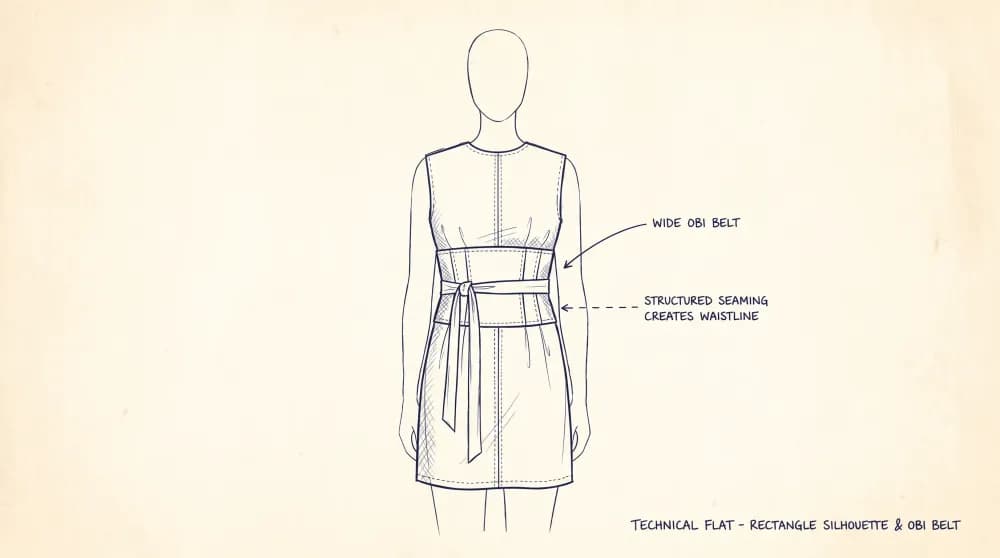
Some days call for a defined waist, and that's a styling choice, not a correction. A belt is the fastest route there: worn over a dress, a coat, or even a loose button-down, it creates a visible break between the upper and lower body, and you can go bold with a wide belt or keep it subtle with a thin one. Peplum tops and jackets do something similar by flaring out just below the waist, which suggests a narrower point above it, and wrap dresses and wrap tops work the same way. The diagonal fold across the body naturally implies a waistline, and the tie lets you decide how defined it looks. A ruffle at the waist or a jacket cut and seamed to nip in at the middle adds dimension in that same spot, and a cropped, cinched blazer thrown over a simple dress or trousers is an easy way to bring any of this in without overhauling the whole outfit.
Dresses That Work With a Rectangle Shape
Dresses give a rectangle shape two genuinely different directions to work with, and neither one is more correct than the other. A shift dress, cut with little to no waist seam, relies on the fabric's own drape and the body's straight line to do the work, and it's arguably the single most iconic dress silhouette for this shape precisely because it doesn't fight the proportions at all. A column dress in a heavier, more structured fabric does something similar for evening, holding a clean vertical line from shoulder to hem.
On the other side, a wrap dress or a belted shirt dress introduces a defined waist without needing much else to happen: the tie or belt does all the work, and you can adjust it looser or tighter depending on how much definition you want that day. A fit-and-flare dress is the most dramatic version of that same idea, fitted through the bodice and waist before releasing into a fuller skirt, which creates a hint of curve where the straight-line proportions don't naturally provide one. All four are legitimate choices. Which one to reach for really comes down to whether you want the outfit to lead with line or with shape on a given day.
Layering for Fall and Winter
Layering is where a rectangle shape has a real head start, since clean lines stack cleanly. A longline coat worn open over a fitted top and straight trousers keeps one continuous vertical line running the full length of the body, which is part of why the oversized-coat trend translates so easily onto this shape. Cropped jackets and cardigans work in the opposite direction, introducing a horizontal break wherever the hem lands, and layering a cropped piece over a longer base layer is a simple way to add visual interest without touching color or pattern at all.
Heavier knitwear, the cable-knit and Fair Isle sweaters showing up everywhere this season, adds volume on top that a straighter body carries well, especially paired with a slimmer bottom so the outfit doesn't read as bulky from head to toe. A belt worn over a bulky sweater or a longline cardigan is a fast way to reintroduce a waistline once a heavier layer goes on, if that's the look you're after that day.
Embracing the Straighter Silhouette
Here's the part that deserves more airtime than it usually gets: a straighter silhouette is a genuine style strength on its own, not a fallback for days you're not "creating curves." Some of fashion's most iconic looks are built entirely around clean, straight lines. A shift dress with no waist seam relies on the fabric and the body's own line to do the work, and on a rectangle shape that line reads clean and intentional rather than shapeless, which is a big part of why shift dresses have stayed a wardrobe staple for decades. A well-cut suit, matching or not, is arguably the single best category for this shape: straight or slightly relaxed trousers with a structured jacket build a strong, cohesive line from shoulder to ankle, which is the exact silhouette menswear-inspired dressing is built on. Boxy, cropped, and oversized jackets work with the shape rather than against it too, and monochrome dressing does something similar, since a single color from top to bottom removes visual breaks and reads as sleek, especially in a structured fabric.
Playing with Proportion for Visual Interest
This is where rectangle body shape outfits get genuinely fun to build, because instead of managing curve, you're designing lines and breaks on your own terms. A cropped jacket or cardigan paired with high-waisted trousers or a skirt creates a horizontal break wherever you choose to put it, which shifts the whole proportion of an outfit. A wide-leg trouser balanced with a more fitted or tucked-in top creates contrast between straight and full lines, and that pairing has become a go-to in current trend cycles for exactly that reason. Layering a longer coat over a shorter top, or a fitted piece under an open jacket, adds depth and breaks up a silhouette without needing any curve at all, and it's one of the simplest ways to add visual interest to a straight-line outfit.
Accessories That Add Definition
Accessories are a low-commitment way to add shape to an outfit without changing the clothing itself. A structured belt bag or a bag with a defined, boxy shape echoes the same clean lines a rectangle shape already wears well, while a soft, slouchy bag introduces a bit of curve into an otherwise straight-line outfit if that's the contrast you're after. Statement earrings or a chunky necklace, both very much in style this year alongside the gold-over-silver shift covered elsewhere on this site, draw the eye up toward the face and shoulders, which pairs naturally with the boxy-jacket and strong-shoulder silhouettes already covered above. None of this is required. It's simply another set of tools alongside the belts and peplum pieces already covered above.
These Are Options, Not Obligations
Every idea above is a tool, not a requirement. Skip the cinched waists and peplum tops entirely if they're not your thing; a clean, straight silhouette in a great fabric is a complete look on its own. Love layering and wide-leg everything? Run with that. Want a fitted waist every single day? That works too. Body shape guides exist to help you shop faster and predict fit, not to hand you a checklist, and personal style always overrides shape "rules." Wear what makes you feel like yourself.
Getting the Fit Right Matters More With Tailoring
Here's the practical catch with rectangle body shape outfits: tailored and structured pieces, the exact category this shape wears so well, show fit issues more visibly than flowy, draped styles do. A blazer that's a half-size off in the shoulders, or trousers that don't sit right at the waist, stands out far more in a structured cut than it would in a soft jersey dress.
That's a good reason to know your actual measurements rather than guess at them. Shaku's two-photo scan gets you real measurements and a size match in seconds, no tape measure needed, so you have a clearer read on how a specific jacket or trouser will actually fit before you buy it. That matters most in exactly the pieces this shape leans on.
Frequently asked questions
How can a rectangle body shape create curves?
Belts, peplum tops, wrap dresses, ruffled waistlines, and cinched jackets are all common ways to introduce a defined waistline. None of these are required. They're simply options if you want that look on a given day.
What silhouettes work well for a rectangle shape without adding a defined waist?
Structured shift dresses, tailored suiting, boxy jackets, and monochrome outfits all work with a straighter silhouette rather than against it. These are strong, trend-aligned choices in their own right, not fallback options.
What dress style is easiest to start with for a rectangle shape?
A shift dress is the lowest-effort place to start, since it needs no waist definition to look intentional. A wrap dress is a good second option if you want to test out a defined waistline without a separate belt or accessory.
Do rectangle body shape outfits need to follow strict rules?
No. Shape guides are a shopping shortcut, not a mandate. Personal preference comes first, whatever that means for you: fitted, straight, or somewhere in between.